
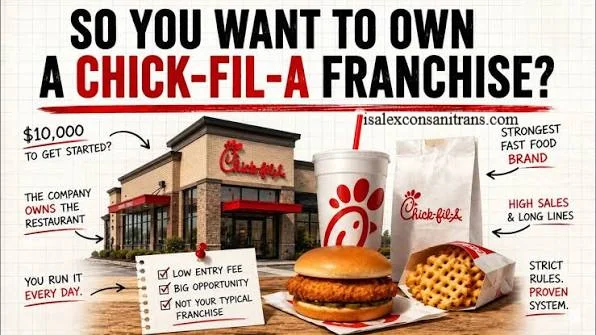
Becoming a Chick-fil-A operator costs a $10,000 franchise fee, and Chick-fil-A, Inc. pays for the land, building, and equipment. In return, the company takes 15% of sales plus 50% of the restaurant’s pretax profit. Operators don’t own the restaurant, and the selection process is among the most competitive in fast food.
That low entry price is the main reason people search for this opportunity. It is also why many people misunderstand it. This guide covers how the model works, what it costs, what operators earn, and what it takes to get chosen.
How does the Chick-fil-A operator model work?
Chick-fil-A calls its franchisees “operators,” and the word is deliberate. In most restaurant systems, a franchisee buys the right to use a brand, funds the build-out, and owns the business. Chick-fil-A reverses this. The company buys the land, funds construction, and keeps each restaurant on its own balance sheet, while approved operators pay a $10,000 fee.
You run the restaurant day to day. You hire and develop the team, manage the budget, and serve the local community. You do not hold equity in the location, and the business can’t be sold or passed to your children. As one franchise analyst told Fox News, the restaurant goes back to Chick-fil-A when an operator retires.
It is closer to a high-stakes, performance-based leadership role than a traditional business purchase. For some candidates that is the appeal. For others it’s a dealbreaker. franchisebusinessreview.com
How much does a Chick-fil-A franchise cost?
Short answer: The franchise fee is $10,000, which is the operator’s main upfront cost. The much larger investment in the property and equipment is made by Chick-fil-A, Inc.
| Cost item | Amount | Who pays |
|---|---|---|
| Initial franchise fee | $10,000 | Operator |
| Land, building and equipment | Roughly $318K to $3.4M+ depending on format, per the 2026 FDD (as reported) | Chick-fil-A, Inc. |
| Ongoing service fee | 15% of sales | Operator, paid monthly |
| Profit share | 50% of pretax profit | Operator, paid monthly |
| Working capital and living expenses | Varies; some sources suggest $15K to $20K | Operator |
The system-wide investment varies by format. Reported ranges run from about $427,000 to $1 million for a delivery kitchen up to $3.4 million or more for a freestanding drive-thru, though figures differ between sources. Always verify against the current Franchise Disclosure Document (FDD), which is the legally binding source.
Why only $10,000? Because you are not buying a restaurant. The fee secures the right to be considered and to operate, and the company recovers its investment through the 15% fee, the profit share, and rent on the property. fransmart.com
How much do Chick-fil-A operators earn?
Short answer: Estimates range from roughly $200,000 to $650,000 a year, depending on sales volume and location type. Chick-fil-A does not publish an official operator salary.
The numbers behind those estimates:
- The company’s FDD showed average sales of $9.3 million in 2024 at freestanding restaurants and $4.5 million at mall locations. A more recent analysis puts the 2026 FDD freestanding average at about $9.16 million, with average freestanding sales down 1.7% in 2025.
- After the 15% fee and 50% profit split, operators reportedly keep around 5% to 7% of revenue. On a $9.3 million restaurant, that works out to about $465,000 to $651,000.
- More conservative estimates land at $200,000 to $300,000 a year.
- Individual results vary widely. In one FDD, the lowest-earning non-mall location had $1.9 million in sales, while the highest reached $19.3 million.
These figures are third-party estimates, not guaranteed income. The FDD reports restaurant sales, not operator take-home pay, and a few sources I found list much lower figures. Treat any single number with caution.
What are the requirements to become a Chick-fil-A operator?
Short answer: There’s no published minimum net worth. Chick-fil-A mainly looks for leadership ability, character, and willingness to run one restaurant full time.
Based on the company’s public statements and independent reporting:
- Full-time commitment. Chick-fil-A says it looks for leaders willing to devote their full time and best efforts to operating a restaurant.
- No competing business interests. Operators can’t be involved in other “non-passive” business interests and usually can’t run more than one restaurant.
- People leadership. The role centers on hiring, coaching, and retaining a large team.
- Community involvement. Operators are expected to serve their local area.
- Personal funds for the fee. Reportedly, the $10,000 can’t be financed.
- Willingness to relocate. Openings depend on where the company builds, not where you live.
Experience in the restaurant itself, such as working as a team member or leader, tends to strengthen a candidacy, though it is not a formal requirement.
How do you become a Chick-fil-A operator?
- Understand the economics. Read the FDD carefully, especially Items 5, 6, 7, and 19. Consider having a franchise attorney review it.
- Apply online. Submit an application through Chick-fil-A’s official franchising page. Don’t pay anyone who claims to sell a spot.
- Go through screening and interviews. The company evaluates leadership, values fit, and personal background over several rounds.
- Complete training. Selected candidates train before taking over a restaurant. Exact length and structure aren’t uniformly published, so confirm with Chick-fil-A.
- Wait for a location. Placement depends on openings. Candidates without Chick-fil-A experience often wait three to five years before receiving an opportunity.
What are the odds of getting selected?
Short answer: Very low, with published estimates between roughly 0.2% and 1% of applicants.
Reported figures conflict. Fox News cited an expert saying about 100,000 people apply each year and roughly 200 are selected. Other outlets cite roughly 60,000 applicants per year or fewer than 1% of over 40,000 applicants accepted. Chick-fil-A doesn’t publish an official acceptance rate. The consistent message is that demand far exceeds supply, so apply with realistic expectations and a backup plan.
Pros and cons of a Chick-fil-A franchise
Pros
- Minimal capital at risk. You avoid the property and equipment costs that typically run into the millions.
- High sales volumes. Average restaurant sales sit well above most fast food rivals. Reported system-wide sales rose from $22.7 billion in 2024 to $23.9 billion in 2025.
- Corporate support. The company handles real estate, construction, and equipment, and supplies training and brand marketing.
- Strong brand and values. Customers recognize it, and the Sunday closure is part of its identity.
- Stability. The operator relationship is built around long-term retention rather than quick resale.
Cons
- No equity. You can’t sell the business or pass it on.
- Heavy revenue sharing. The 15% fee plus 50% profit split leaves a modest share of revenue.
- Single-unit limit. Multi-unit ownership is generally not allowed.
- Exclusive commitment. Other active business interests are restricted.
- Long odds and long waits. Many strong candidates never get a location.
- Slower sales growth. Average freestanding sales dipped in 2025, so growth is coming from new restaurants more than bigger ones.
Is there a Chick-fil-A franchise for sale or an international option?
Chick-fil-A restaurants aren’t listed for sale, because operators don’t own them and can’t resell them. Anyone offering a Chick-fil-A franchise for sale is almost certainly not legitimate.
Internationally, the company’s franchising is overwhelmingly U.S.-focused. Overseas ventures have been limited and, as far as I can find, not open to individual operator applications. Check Chick-fil-A’s official franchising page for current availability.
What are the alternatives to a Chick-fil-A franchise?
If the odds or the no-equity structure don’t suit you, other fast food and restaurant franchises offer real ownership, with far higher upfront costs. A 2026 comparison reports entry points from about $120K for Domino’s, $204K for Jersey Mike’s, and $239K for Subway. Chicken-focused and casual concepts such as Church’s Texas Chicken, East Coast Wings & Grill, and Pizza Factory are also worth evaluating. Compare each brand’s FDD for fees, royalties, and support.
Is a Chick-fil-A franchise worth it?
Short answer: For the right candidate, yes. For someone who wants equity, multiple units, or a quick start, probably not.
It works best for a hands-on leader who wants high earning potential without risking millions, and who is comfortable with the company retaining ownership. It works poorly for investors who want an asset to build, sell, or hand down. A useful way to frame it: you are applying for a well-paid, high-responsibility leadership position with a brand, not buying a business.

Frequently Asked Questions
Q: What is the Chick-fil-A franchise cost?
A: The franchise fee is $10,000. Chick-fil-A, Inc. pays for the land, building, and equipment, which can run from several hundred thousand dollars to over $3 million depending on the format. Operators then pay 15% of sales plus 50% of pretax profit. Confirm details in the current Franchise Disclosure Document.
Q: Is there a Chick-fil-A franchise for sale?
A: No. Chick-fil-A restaurants aren’t sold, because operators don’t own them and can’t resell or transfer them. You can only apply to become an operator through the company.
Q: What is the Chick-fil-A franchise owner salary?
A: Chick-fil-A doesn’t publish an official figure. Third-party estimates range from roughly $200,000 to $650,000 a year, depending on restaurant sales and location type. Treat these as estimates, not guarantees.
Q: Why does it only cost $10K to own a Chick-fil-A franchise?
A: Because you don’t own it. The $10,000 is a franchise fee, and Chick-fil-A funds and retains ownership of the property and equipment. The company earns its return through a 15% fee on sales, a 50% share of pretax profit, and rent.
Q: Is there a Chick-fil-A franchise waiting list?
A: There’s no public waiting list. Applicants go through a competitive selection process, and those without prior Chick-fil-A experience often wait several years for an opportunity, as reported in 2026.
Q: Does Chick-fil-A franchise internationally?
A: Chick-fil-A’s operator program is overwhelmingly U.S.-based. Its international presence has been limited and generally isn’t open to individual operator applications. Check the official franchising page for current information.
Q: Where is the Chick-fil-A franchise application online?
A: Apply through the franchising section of Chick-fil-A’s official website. Don’t pay third parties who claim to guarantee a spot, because the company doesn’t sell placements.
Q: Is a Chick-fil-A franchise worth it?
A: It can be for a full-time, hands-on leader who wants strong earning potential without a multimillion-dollar investment. It’s less suitable for anyone who wants equity, multiple units, or an asset to sell or pass down.
Author Bio: Hamid Ali is a business and finance writer specializing in franchise opportunities, startup costs, business ownership, and investment insights. He creates research-driven guides to help readers make informed business decisions.
Author Name: Hamid Ali
Email: johanharwen314@gmail.com
Also Read: