

Most startups don’t fail because they lacked software. They fail because they bought too much of it too early, or picked tools that couldn’t answer the questions that mattered. This guide covers what startup growth tools do, which categories to prioritize, how to evaluate vendors, and how to adapt your stack as the company matures.
One note on terminology: “growth navigate startup tools” isn’t a single standardized product category. People use it to mean software that helps founders research markets, manage customers, run marketing, and track performance. This article treats it that way.
What Are Startup Growth Tools?
Startup growth tools are software products that help early-stage companies find customers, manage relationships, automate repetitive work, and measure results so they can make decisions with data instead of guesses.
They typically fall into six groups:
- Market and investor research (company and funding databases)
- Sales and CRM (lead management, sales pipeline tracking)
- Marketing automation (email, lifecycle campaigns, customer acquisition)
- Analytics and business intelligence (product analytics, dashboards)
- Operations and collaboration (project management, team communication)
- Finance (accounting software, cash flow and runway tracking)
Why Do Startups Need Growth Tools?
Because small teams can’t afford manual processes that eat hours without producing insight. A three-person team still needs to follow up with leads, report to investors, and understand why customers leave.
The right tools help with three things:
- Speed: Automated workflows replace copy-and-paste tasks.
- Visibility: Shared dashboards show what is working without waiting for a monthly report.
- Discipline: Tracking metrics like customer acquisition cost (CAC), monthly recurring revenue (MRR), and burn rate forces honest conversations about the business.
A caution from experience: tools don’t create product-market fit. They help you measure whether you have it. If retention is weak, better dashboards will show you the problem, but won’t fix it.
What Should You Look for in Startup Growth Tools?
Prioritize integration, usability, scalability, and total cost, in that order. Feature lists matter less than whether your team will actually use the tool.
- Integrations: Does it connect to your CRM, billing system, and communication tools? Disconnected software creates data silos.
- Time to value: Can someone set it up in days rather than weeks?
- Pricing that scales: Many SaaS subscriptions look cheap at five seats and expensive at fifty. Check how pricing changes with contacts, events, or users.
- Data export: You should be able to leave without losing your data.
- Fit for your stage: An enterprise suite is usually a mistake for a pre-revenue team.
Best Growth Navigate Startup Tools in 2026 (By Function)
The tools below are widely used and well documented. This is not a ranking, and the best option depends on your model. Pricing and plan limits change, so verify before committing.
Crunchbase: Company and Funding Research
Crunchbase is a database of companies, funding rounds, and investors. Founders commonly use it to build investor lists, study competitors’ funding history, and research prospective customers. It offers free access with limits, with deeper data on paid plans. It works best at the fundraising and market-mapping stages.
Dealroom: Ecosystem and Market Intelligence
Dealroom is a data platform focused on startups, venture capital, and regional ecosystems, with particularly strong coverage in Europe. It’s useful if you’re researching sectors, comparing ecosystems, or sizing a market. It is more research-oriented than operational, so most teams pair it with a CRM rather than replacing one.
Attio: Flexible CRM for Startup Management
Attio is a newer, customizable CRM built around a flexible data model. Instead of forcing every business into a fixed contacts-and-deals structure, you can shape objects and fields around how your company sells. That suits startups with unusual sales motions, such as partnerships, marketplaces, or investor relations tracked alongside customers. If you prefer a more established ecosystem with a free tier, HubSpot’s CRM is the common alternative.
ActiveCampaign: Marketing Automation and Lifecycle Email
ActiveCampaign combines email marketing, automation, and CRM features. It’s strong for behavior-based sequences such as onboarding emails, trial nurturing, and win-back campaigns. That makes it relevant for customer retention as well as acquisition. Because automation can get complicated quickly, start with two or three workflows and expand only when they perform.
Sales and Outreach
For outbound sales, startups often use lead databases and sequencing tools such as Apollo.io, Lemlist, or Instantly. Whatever you choose, pay attention to email deliverability and compliance rules (CAN-SPAM in the US, and GDPR if you contact people in Europe or the UK). Cheap volume that lands in spam isn’t growth.
Analytics and Business Intelligence
- Product analytics: Mixpanel, Amplitude, and PostHog track how users behave inside your product, which helps you understand activation and retention.
- Web analytics: Google Analytics 4 covers acquisition channels and site behavior.
- Dashboards: Looker Studio and Metabase pull data from multiple sources into shared business dashboards.
Start with the question, not the tool. “Which channel brings customers who stay past 90 days?” is a better starting point than “we need real-time data.”
Operations, Finance, and Automation
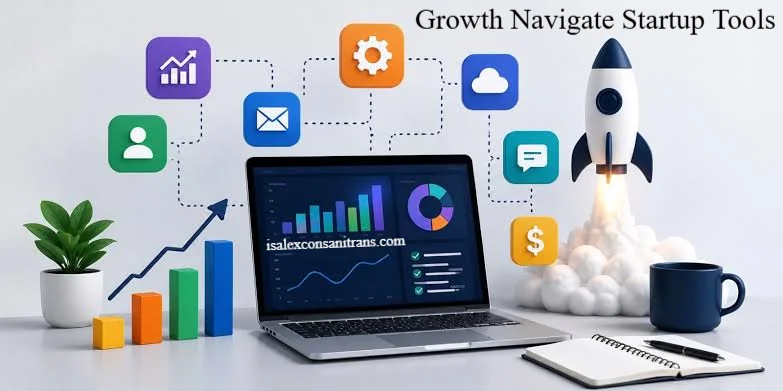
- Project and task management: Notion, Asana, ClickUp, and Linear are common choices, along with Slack for team communication.
- Accounting and finance: QuickBooks and Xero handle bookkeeping, and startup-focused banking and spend platforms such as Mercury and Brex add cash visibility.
- Workflow automation: Zapier and Make connect apps without custom code, which is useful before you can hire engineers for internal tooling.
Which Metrics Should Your Tools Help You Track?
At minimum: MRR, CAC, customer lifetime value (LTV), burn rate, and runway. Pick tools that can report these without heroic spreadsheet work.
| Metric | What it tells you | Simple formula |
|---|---|---|
| MRR | Predictable monthly revenue | Sum of recurring subscription revenue per month |
| CAC | Cost to win a customer | Sales and marketing spend ÷ new customers |
| LTV | Value of a customer over time | Average revenue per customer × expected lifetime (adjust for margin) |
| Burn rate | How fast you spend cash | Cash out minus cash in, per month |
| Runway | How long cash lasts | Cash on hand ÷ net monthly burn |
A rule of thumb many investors cite is that LTV should comfortably exceed CAC, but acceptable ratios vary by model, so treat any benchmark as a starting point rather than a verdict.
How Do You Choose the Right Startup Tools?
Choose by problem, not by popularity. A five-step process works well:
- List your three biggest bottlenecks (for example, lead follow-up, reporting, or invoicing).
- Map each to a tool category rather than a specific brand.
- Shortlist two or three options and check integrations with what you already use.
- Run a trial with real data and one owner responsible for the decision.
- Review after 60 to 90 days. If nobody opens it weekly, cancel it.
Which Startup Tools Fit Each Growth Stage?
| Stage | Priorities | Typical tool types |
|---|---|---|
| Idea / pre-launch | Validate demand, research market | Company databases, simple CRM or spreadsheet, shared docs |
| Early traction | Capture leads, learn from users | Free-tier CRM, email automation, web and product analytics |
| Growth | Repeatable sales, retention | Full CRM, marketing automation, BI dashboards, finance tooling |
| Scale | Governance, efficiency, reporting | Integrated stack, data warehouse, formal finance systems |
Notice how little you need at the start. A spreadsheet and a free CRM can carry a startup further than most founders expect.
What Mistakes Should You Avoid When Buying Startup Tools?
- Buying for the company you hope to be. Scale up when the pain is real.
- Tool sprawl. Every added subscription needs an owner, a budget line, and an integration plan.
- Ignoring seat and usage pricing. Costs can jump when your team or contact list grows.
- Skipping data hygiene. A CRM full of duplicates produces unreliable reports.
- Automating a broken process. Fix the workflow first, then automate it.
- Never auditing. Review subscriptions quarterly, since unused SaaS subscriptions quietly drain runway.
Frequently Asked Questions
Are growth navigate startup tools free?
Some are, but usually with limits. Many CRM, analytics, and research platforms offer free tiers with caps on contacts, events, or data access, and paid plans unlock automation, integrations, and deeper data. Because plans change frequently, check each vendor’s pricing page before relying on a free tier.
What are the best growth navigate startup tools?
There isn’t one best option, because it depends on your stage and needs. Commonly used choices include Crunchbase or Dealroom for research, Attio or HubSpot for CRM, ActiveCampaign for marketing automation, Mixpanel, Amplitude, or PostHog for product analytics, and QuickBooks or Xero for accounting. Start with the problem you need to solve, then pick the simplest tool that solves it.
What does “startup booted” mean?
It most likely refers to a bootstrapped startup, meaning a company funded by its founders and early revenue rather than outside investors. Bootstrapped teams usually favor free or low-cost tools, tight cash flow tracking, and a lean software stack. If you meant something else, such as a specific product, check that source for its definition.
Author Bio: Hamid Ali is a business and technology writer covering startup growth, SaaS tools, digital marketing, and AI automation. He creates practical, research-driven guides to help founders choose software and build efficient business workflows.
Author Name: Hamid Ali
Email: johanharwen314@gmail.com
Also Read: