
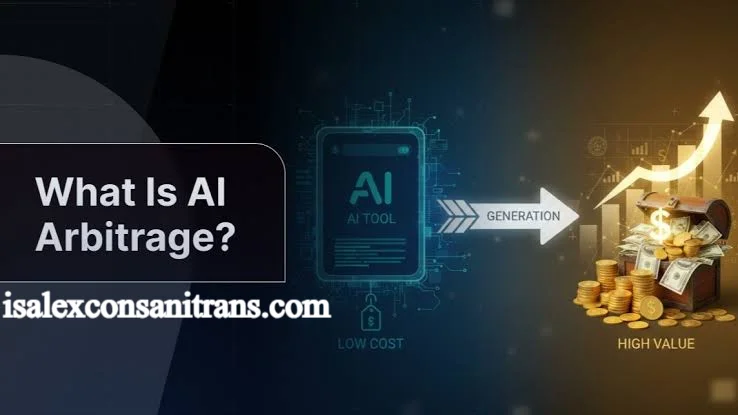
AI has changed how businesses produce content, analyze information, communicate with customers, generate leads, and complete repetitive tasks. As these tools become more capable, a new business concept has gained attention: AI arbitrage.
So, what is AI arbitrage? In the business context, it generally means using AI to deliver a service or business outcome at a lower time or labor cost while capturing value from the resulting efficiency. A company may use AI tools to perform much of the research, drafting, analysis, or automation while humans remain responsible for strategy, quality control, judgment, and customer relationships.
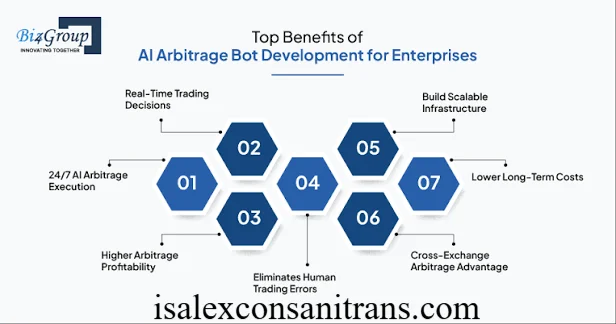
There is also a separate financial meaning. In trading, AI arbitrage can refer to using algorithms to identify and potentially act on temporary price differences between markets or related assets.
These two concepts share the word arbitrage, but they solve different problems.
This guide explains how AI arbitrage works, where businesses are using it, which models can be built around it, the tools involved, and the risks entrepreneurs should understand before treating AI as a business advantage.
What Is AI Arbitrage?
AI arbitrage is the practice of using artificial intelligence to reduce the resources required to produce a valuable business outcome.
The basic idea is easier to understand with a simple example.
Imagine an agency charges a client $1,000 for a content package. Traditionally, employees might spend many hours researching topics, creating outlines, writing drafts, preparing images, and compiling reports.
With an AI-assisted workflow, some of those repetitive tasks could be completed much faster. The agency still has expenses, including software, employees, editing, management, sales, and other overhead, but the amount of manual work required for each deliverable may fall.
That creates an AI efficiency gap between:
- The value or price associated with the finished outcome
- The cost of producing that outcome
- The amount of time and labor saved through AI
The important point is that AI arbitrage is not simply selling AI-generated output. Sustainable businesses generally need to add something beyond raw automation, such as expertise, editing, personalization, strategy, implementation, or accountability.
AI Arbitrage vs. Traditional Arbitrage
Traditional arbitrage usually involves exploiting a price difference for the same or closely related asset in different markets.
For example, if an asset can be purchased for one price in one marketplace and simultaneously sold for a higher price elsewhere, a trader may attempt to capture the difference, subject to transaction costs and execution risks.
AI arbitrage in a service business is different.
| Traditional Arbitrage | AI Business Arbitrage |
|---|---|
| Focuses on price differences | Focuses on efficiency differences |
| Common in financial markets | Common in services and operations |
| Often depends on market timing | Often depends on workflow design |
| Algorithms can identify opportunities | AI can automate or accelerate work |
| Transaction costs matter | Labor, software, and operating costs matter |
The two should therefore not be treated as identical strategies.

How Does AI Arbitrage Work?
AI arbitrage works by identifying tasks that consume significant time or labor and determining whether AI can perform or accelerate those tasks without compromising the required outcome.
A practical workflow usually looks like this:
1. Identify an Expensive or Time-Consuming Task
Start with a business process rather than a particular AI tool.
Examples include:
- Keyword research
- Content briefs
- Customer support triage
- Lead qualification
- Data organization
- Social media drafts
- Product descriptions
- Market research
- Internal reporting
2. Determine What AI Can Handle
Not every task should be automated.
AI is often useful for repetitive, structured, or information-heavy work. Tasks requiring sensitive judgment, accountability, complex negotiation, or specialized expertise may still need substantial human involvement.
3. Build an Automated Workflow
The business can connect AI tools, databases, automation software, and human review into a repeatable process.
For example:
Customer inquiry → AI classification → Draft response → Human review → Customer response
This is an example of human AI collaboration, rather than complete replacement of the human workflow.
4. Measure the Economics
A business should compare:
Revenue generated − total delivery costs = contribution margin
AI software is only one part of the calculation.
A realistic cost assessment can include:
- AI subscriptions or API usage
- Employee time
- Human review
- Automation software
- Data costs
- Management
- Customer acquisition
- Error correction
- Compliance requirements
5. Improve the Process
If the workflow produces consistent results, the business can standardize it and potentially handle more customers without increasing labor at the same rate.
That is where AI scalability becomes important.
Types of AI Arbitrage Businesses
AI arbitrage can appear in many forms. The most common models are based on services that contain repetitive tasks that AI can accelerate.
1. AI Content Arbitrage
Content production is one of the most obvious applications.
An AI-assisted content operation may use AI for:
- Topic research
- Content outlines
- First drafts
- Headline variations
- Meta descriptions
- Content summaries
- Social media repurposing
- Basic image concepts
A human editor can then verify accuracy, improve the writing, add original insights, and ensure that the content meets the client’s requirements.
This model can be particularly useful for agencies managing large content calendars.
However, simply generating large volumes of generic AI-generated content does not automatically create a competitive advantage. Quality, originality, factual accuracy, editorial judgment, and distribution still matter.
2. AI Automation Arbitrage
Automation arbitrage focuses on replacing repetitive manual workflows with automated systems.
For example:
Form submission → AI classification → CRM update → personalized email → sales notification
A company could offer this as an AI automation service to businesses that still handle the same process manually.
The value is not necessarily the AI model itself. The value can come from understanding the client’s process and implementing a system that works reliably.
3. AI Lead Generation
Lead generation can involve substantial repetitive research.
AI can assist with:
- Prospect research
- Lead qualification
- Data enrichment
- Personalized outreach drafts
- CRM organization
- Follow-up scheduling
- Customer segmentation
A human salesperson can remain responsible for relationship building and important conversations.
This makes lead generation an example of an AI-powered business process rather than a completely autonomous sales operation.
4. AI Design and Video Services
AI image and video tools can accelerate creative production.
Businesses can use AI for:
- Concept development
- Storyboards
- Ad variations
- Social media visuals
- Product concepts
- Short-form video ideas
- Background generation
- Creative variations
The strongest service models generally combine AI generation with human creative direction, editing, brand consistency, and client feedback.
AI Arbitrage in E-Commerce
E-commerce businesses can also use AI to improve operational efficiency.
Potential applications include:
- Product description generation
- Customer support
- Product categorization
- Demand analysis
- Competitor monitoring
- Marketing copy
- Recommendation systems
- Inventory analysis
For example, an online retailer with thousands of products could use AI-assisted workflows to create initial product descriptions and categorize products before human review.
The economic benefit comes from reducing repetitive work rather than simply generating more text.
AI Arbitrage in Customer Support
Customer service is another area where AI automation can reduce repetitive workloads.
An AI customer support workflow might:
- Receive a customer request.
- Identify its category.
- Search approved knowledge sources.
- Draft an answer.
- Escalate complicated cases.
- Record the interaction.
Human agents can handle complaints, unusual situations, refunds, sensitive cases, and questions that require judgment.
This approach can improve response speed while preserving human oversight.
AI Arbitrage in Financial Markets
The term has a different meaning in finance.
AI trading arbitrage generally involves algorithms analyzing financial data to identify potential pricing inefficiencies.
Possible areas include:
- Cryptocurrency arbitrage
- Cross-market price differences
- Statistical relationships between assets
- ETF and underlying-asset pricing relationships
- Algorithmic trading strategies
The basic concept is straightforward, but executing it successfully is much more complicated.
A theoretical price difference may disappear after accounting for:
- Trading fees
- Bid-ask spreads
- Slippage
- Taxes
- Latency
- Liquidity
- Withdrawal restrictions
- Market impact
- Technology failures
Therefore, identifying an apparent opportunity does not necessarily mean that a profitable trade exists.
AI trading should also not be confused with guaranteed profits. Financial markets are uncertain, and automated systems can lose money.
Best AI Tools for Arbitrage Workflows
The best tool depends on the task rather than the popularity of the software.

ChatGPT
ChatGPT can be used for tasks such as brainstorming, drafting, analysis, research assistance, coding, summarization, and workflow development.
For businesses, its usefulness comes from integrating it into a broader process rather than treating it as a replacement for every human task.
Claude
Claude is another AI assistant that can support writing, analysis, coding, and other knowledge-work tasks.
Businesses should evaluate AI models according to the particular workflow, including output quality, context handling, reliability, cost, integrations, and privacy requirements.
AIsuites.ai
AISuites.ai is positioned as an all-in-one AI workspace combining AI search, chat, image generation, video creation, voice tools, avatar generation, and translation in one platform.
For users building AI-powered workflows, having multiple capabilities available in one workspace can simplify the process of moving between different creative and productivity tasks.
The important principle is to choose tools based on the workflow’s requirements rather than selecting software simply because it is popular.
How to Build an AI Arbitrage Strategy
If you want to build an AI arbitrage business, start with the economics rather than the technology.
Step 1: Choose a Specific Service
Examples include:
- SEO content
- Social media management
- Lead generation
- Customer support
- Video production
- Business research
- Data processing
- Marketing automation
Step 2: Map the Existing Workflow
Write down every step required to deliver the service.
Separate the work into:
Automatable → AI-assisted → Human-only
This prevents businesses from trying to automate processes that require human judgment.
Step 3: Calculate the Baseline Cost
Determine how much time and money the existing process requires.
Then calculate the cost after implementing AI.
Step 4: Add Quality Control
Create clear rules for:
- Accuracy
- Brand voice
- Privacy
- Formatting
- Compliance
- Human approval
- Error handling
Step 5: Test Before Scaling
Run a small pilot and compare the AI-assisted workflow with the previous process.
Measure:
- Time saved
- Error rate
- Customer satisfaction
- Delivery cost
- Revenue per employee
- Revision rate
Step 6: Standardize
Once the process works consistently, document it.
Standard operating procedures can make automated workflows easier to maintain and delegate.
AI Arbitrage Advantages
AI arbitrage can create several potential business advantages.
Lower Delivery Costs
AI can reduce the amount of manual labor required for suitable tasks.
Faster Turnaround
Automated systems can perform certain repetitive activities much faster than manual workflows.
Greater Scalability
A standardized AI workflow can potentially process more work without increasing headcount at the same rate.
New AI Business Opportunities
Entrepreneurs can build services around implementation, automation, consulting, content operations, customer support, and other AI-enabled processes.
More Time for Higher-Value Work
When repetitive tasks are reduced, employees can spend more time on strategy, creative decisions, relationships, and complex problems.
AI Arbitrage Risks You Should Understand
AI arbitrage is not effortless money. Several risks can reduce or eliminate the expected efficiency advantage.
1. Falling Margins
If competitors gain access to similar AI tools, the same efficiency improvement may become standard across the industry.
The competitive advantage can therefore disappear.
2. Quality Problems
AI systems can produce incorrect, incomplete, outdated, or unsuitable outputs.
Human oversight remains important for consequential work.
3. Data Quality
Poor inputs can lead to poor outputs. Businesses using AI for analysis or automated decision-making need reliable and appropriately sourced data.
4. Copyright and Ownership Questions
AI-generated content can raise intellectual-property questions that vary by jurisdiction and by the nature of human involvement.
Businesses should not assume that every AI-generated output has the same legal status as conventional human-created work.
5. Privacy and Security
Sensitive customer or company information should not automatically be placed into an AI system. Businesses need appropriate data-handling policies and should understand how their chosen tools process information.
6. Technology Dependence
An API outage, software change, pricing change, or integration failure can interrupt an AI-dependent workflow.
A good system should have fallback procedures.
7. Regulatory and Compliance Risk
Industries such as finance, healthcare, insurance, and legal services can have additional requirements. Automating a workflow does not remove the organization’s responsibility for complying with applicable rules.
Is AI Arbitrage Profitable?
AI arbitrage can be profitable when AI creates a meaningful and sustainable reduction in delivery costs while the business continues to provide valuable outcomes.
Profitability depends on more than cheap AI software.
A useful framework is:
Profit = Revenue − Labor − AI Costs − Software − Overhead − Customer Acquisition − Error Costs
Suppose an agency charges $2,000 for a service.
If its total cost of delivery is $1,500, its gross contribution before other relevant expenses is $500.
If a well-designed AI workflow reduces the delivery cost to $1,000 while maintaining the required quality, the economics change.
But if competitors offer the same service for $1,100 after adopting similar automation, the original advantage may shrink.
That is why AI efficiency alone is not necessarily a long-term moat.
Expertise, proprietary data, customer relationships, distribution, workflow design, brand reputation, and specialized knowledge can be harder for competitors to copy.
AI Arbitrage vs. AI Automation
These terms are related but not identical.
AI automation describes the technology and process used to automate work.
AI arbitrage describes the economic opportunity created when that technology changes the cost or speed of delivering an outcome.
For example:
Automating customer-support ticket classification is AI automation.
Selling a customer-support service at a fixed price while AI significantly reduces the cost of handling suitable tickets is an example of the economic logic behind AI arbitrage.
Understanding this distinction makes the concept much easier to apply.
The Future of AI Arbitrage
As AI becomes more widely adopted, the simple advantage of having access to an AI tool is likely to become less distinctive.
The more important question will increasingly be:
What can your business build around the technology that competitors cannot easily replicate?
That could include:
- Better proprietary workflows
- Industry-specific expertise
- High-quality proprietary data
- Better customer relationships
- Stronger quality-control systems
- Faster implementation
- Better integrations
- Specialized AI consulting
- Reliable human oversight
In other words, the future of AI automation may move from simply using AI toward designing reliable AI-powered operating systems for specific business problems.
Frequently Asked Questions
What is AI arbitrage in simple terms?
AI arbitrage means using artificial intelligence to reduce the time, labor, or cost required to deliver a valuable business outcome while capturing part of the resulting efficiency.
How does AI arbitrage work for businesses?
Businesses identify repetitive or expensive tasks, use AI to automate or accelerate suitable parts of the workflow, and retain human oversight where judgment and quality control are required.
What are some AI arbitrage examples?
Examples include AI-assisted content creation, lead generation, customer support, marketing automation, design and video services, e-commerce operations, data analysis, and certain algorithmic trading applications.
Is AI arbitrage profitable?
It can be profitable when AI produces meaningful cost or time savings and the business continues to provide sufficient value, quality, and differentiation. Profitability is not guaranteed.
What is the AI efficiency gap?
The AI efficiency gap describes the difference between the value of an outcome and the resources required to produce it after AI improves the workflow. The exact financial benefit depends on labor, software, overhead, quality-control, and other costs.
FAQs
What is AIsuites.ai?
AISuites.ai is an all-in-one AI platform that combines AI search, chat, image generation, video creation, voice tools, avatar generation, and language translation inside one role-based AI workspace.
How is AIsuites different from ChatGPT or other AI tools?
AIsuites.ai is designed as a connected workspace that brings several AI capabilities together, including search, chat, image, video, voice, avatar, and translation functions. ChatGPT and other individual AI products may focus primarily on particular assistant, model, or workflow experiences.
The practical difference depends on which tools and workflows a user needs.
Do I need technical skills to use AIsuites?
No. The platform is designed for creators, marketers, founders, teams, and operators who want to use AI tools without necessarily having advanced technical knowledge.
Technical skills can still be useful when building more advanced integrations or automated workflows.
Is AIsuites an AI browser or a platform?
AIsuites is positioned as an AI platform rather than simply an AI browser. It brings multiple AI capabilities, tools, model access, and role-based workflows into one workspace.
What does the role-based dashboard do?
The role-based dashboard is designed to organize tools, prompts, and workflows according to the user’s role, helping users access the functions most relevant to their work.
Author Bio: Hamid Ali is a technology and digital marketing writer covering AI automation, emerging AI business models, SEO, and online growth strategies. He focuses on explaining complex technology trends in practical, easy-to-understand language for business owners and digital professionals.
Author Name: Hamid Ali
Email: johanharwen314@gmail.com
Also Read:
John Galliano Dior
Salad and Go Near Me
What Is Target Plus Items?

[…] What Is AI Arbitrage […]