Introduction
If you have ever searched for a simple way to invest in the biggest tech companies in America, you have probably come across two tickers that look almost identical. QQQ and QQQM both track the Nasdaq 100 index, yet many investors get confused about which one to pick. Understanding the difference between QQQ and QQQM can actually save you money and help you build a smarter portfolio over time.
In this article, we will break down everything you need to know. We will look at fees, liquidity, tax treatment, dividends, and which fund fits different types of investors. By the end, you will know exactly which fund suits your goals, whether you are a beginner or a seasoned trader.
What Is the Difference Between QQQ and QQQM?
At their core, both funds hold the same 100 companies. They are managed by Invesco, and they follow the exact same index rules. So where does the difference between QQQ and QQQM actually show up?
The answer comes down to structure, cost, and purpose.
- QQQ launched in 1999 and became one of the most traded ETFs in the world.
- QQQM launched in 2020 as a lower cost version built for long term holders.
- QQQ is designed for active traders who need deep liquidity.
- QQQM is designed for investors who plan to hold shares for years.
Think of QQQ as the original, high traffic highway. QQQM is the quieter side road that gets you to the same destination, just with a smaller toll.
How Do QQQ and QQQM Work?
Both ETFs work by pooling investor money and buying shares of the 100 largest non financial companies listed on the Nasdaq exchange. This includes major names in technology, healthcare, and consumer goods.
When you buy a share of either fund, you instantly own a small piece of all 100 companies. That is the beauty of index investing. You do not need to pick individual stocks or guess which company will win next quarter.
Since both funds mirror the same index, their daily price movements are nearly identical. If the Nasdaq 100 rises 2 percent, both QQQ and QQQM should rise close to 2 percent as well.
Which ETF Has Lower Fees, QQQ or QQQM?
This is one of the most searched questions, and for good reason. Fees eat into your returns every single year, so this matters a lot for long term investors.
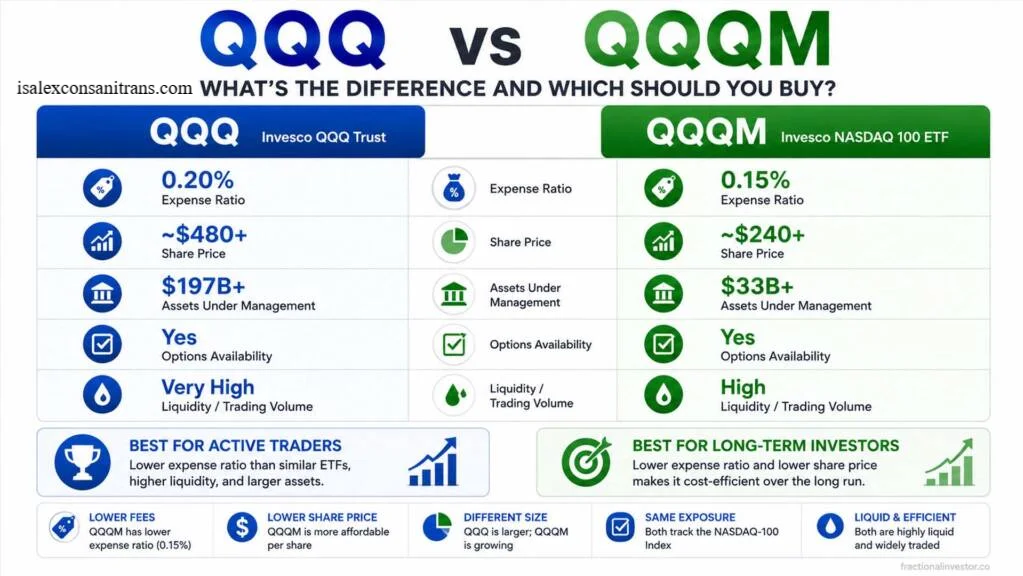
- QQQ charges an expense ratio of 0.20 percent.
- QQQM charges an expense ratio of 0.15 percent.
That might sound like a tiny gap, but over decades it adds up. On a 100000 dollar investment held for 20 years, that 0.05 percent gap could save you thousands of dollars in fees alone. This fee gap is actually the biggest driver behind the difference between QQQ and QQQM for most everyday investors.
Do QQQ and QQQM Track the Same Index?
Yes. Both funds track the Nasdaq 100 index without any variation. There is no difference in the companies held or the weighting strategy. This means performance between the two funds stays almost identical year after year, aside from the small fee difference.
If you check historical charts, you will notice the lines are nearly impossible to tell apart. The only separation comes from that 0.05 percent annual fee gap.
Which ETF Has Higher Trading Volume?
QQQ dominates when it comes to trading volume. It is one of the most actively traded ETFs on the planet, with millions of shares changing hands daily. QQQM trades far less by comparison.
Here is why that matters:
- High volume means tighter bid ask spreads.
- Tighter spreads mean lower hidden trading costs.
- Traders who buy and sell often benefit more from QQQ.
- Long term holders barely notice the volume difference since they trade rarely.
So if you plan to trade options or move in and out of positions frequently, QQQ gives you smoother execution.
Is QQQ Better Than QQQM for Long Term Investing?
Honestly, not really. For long term investing, QQQM tends to win because of its lower expense ratio. Since long term investors are not trading daily, the tighter spreads of QQQ offer little benefit to them.
I always tell people the same thing. If you are opening a position and forgetting about it for ten or twenty years, the fund with lower fees usually comes out ahead. That is QQQM in this case.
Should Beginners Buy QQQ or QQQM?
For most beginners, QQQM makes more sense. Here is why:
- The share price of QQQM is usually lower, making it easier to buy full shares with a smaller budget.
- The lower expense ratio helps beginners keep more of their returns.
- Beginners rarely trade often, so QQQ’s liquidity advantage does not apply to them.
That said, QQQ is not a bad choice either. It is simply better suited for people who trade actively or use options strategies.
Which ETF Is Better for Retirement Accounts?
Retirement accounts like an IRA or 401k are built for long term growth. Since you are not trading daily inside these accounts, QQQM often makes more sense thanks to its lower fees.
Over 30 years of retirement saving, even small fee savings compound significantly. Many financial advisors now recommend QQQM specifically for retirement portfolios because it was built with that exact purpose in mind.
Is QQQM More Tax Efficient Than QQQ?
Both funds are structured similarly and follow standard ETF tax rules, so major tax differences are minimal. However, some investors argue QQQM can be slightly more tax efficient because of lower turnover in certain scenarios and its newer fund structure.
For most investors, the tax treatment between the two is close enough that fees matter more than taxes when deciding.
Dividend Comparison Between QQQ and QQQM
Both funds pay quarterly dividends, and since they hold identical companies, the dividend yield is nearly the same. The small expense ratio difference means QQQM investors may see a marginally higher net dividend payout after fees, though the difference is small.
Can I Switch From QQQ to QQQM?
Yes, you can sell your QQQ shares and buy QQQM shares. However, selling triggers a taxable event if your shares have gained value and are held in a regular brokerage account. Inside a retirement account like an IRA, switching causes no tax consequences at all.
Before switching, weigh the tax cost against the long term fee savings. Sometimes it makes sense to simply hold your existing QQQ shares and direct new contributions into QQQM instead.
Are QQQ and QQQM Good Growth Investments?
Both funds have delivered strong growth historically because they are packed with leading technology and innovation companies. Past performance never guarantees future results, but the Nasdaq 100 has outperformed many broader indexes over the past decade.
If you want exposure to companies driving innovation in artificial intelligence, cloud computing, and consumer technology, either fund gives you that exposure at a low cost.
Portfolio Allocation Strategies Using QQQ and QQQM
Some investors use both funds strategically. For example:
- Hold QQQ in a taxable brokerage account for flexibility and liquidity.
- Hold QQQM in a retirement account to maximize long term fee savings.
- Use QQQ for options trading while using QQQM for buy and hold positions.
This blended approach lets you enjoy the strengths of each fund depending on the account type.
Pros and Cons of Each Nasdaq 100 ETF
QQQ Pros
- Extremely high liquidity
- Great for options trading
- Long track record since 1999
QQQ Cons
- Higher expense ratio
- Higher share price
QQQM Pros
- Lower expense ratio
- Lower share price, easier for small investors
- Built specifically for long term holding
QQQM Cons
- Lower trading volume
- Newer fund with a shorter track record
Final Thoughts
The difference between QQQ and QQQM ultimately comes down to your investing style. If you trade often or use options, QQQ gives you better liquidity. If you are building wealth slowly over years or decades, QQQM helps you keep more of your returns thanks to its lower fees.
Both funds track the same index and hold the same companies, so you cannot really go wrong with either choice. The real decision is about matching the fund to your personal strategy.
What matters most is that you start investing consistently, regardless of which ticker you choose. Which one fits your strategy better? Feel free to share your thoughts or pass this along to a friend who is still deciding between QQQ and QQQM.
Frequently Asked Questions
1. What is the main difference between QQQ and QQQM? The main difference between QQQ and QQQM is the expense ratio and trading volume. QQQM charges lower fees while QQQ offers higher liquidity.
2. Which ETF should I choose for long term investing? QQQM is generally better for long term investing because of its lower expense ratio.
3. Do QQQ and QQQM pay the same dividends? Yes, both pay similar dividend yields since they hold identical companies.
4. Is QQQM a new version of QQQ? QQQM is a separate fund launched later, designed as a lower cost alternative for long term holders.
5. Can I hold both QQQ and QQQM together? Yes, many investors hold both depending on the account type and their trading habits.
6. Which fund has a lower share price? QQQM typically has a lower share price, making it easier for beginners to buy full shares.
7. Does the difference between QQQ and QQQM affect performance? Performance is nearly identical since both track the same index. The fee gap is the biggest factor.
8. Is QQQ safer than QQQM? Neither fund is inherently safer since they hold the same underlying companies and carry the same market risk.
9. Which ETF is better for options trading? QQQ is better for options trading because of its much higher trading volume and liquidity.
10. Should retirees choose QQQ or QQQM? Retirees focused on long term holding often prefer QQQM due to its lower ongoing fees.
isalexconsanitrans.com
Email: johanharwen314@gmail.com
Author Name: Hamid Ali
About the Author: Hamid Ali is a finance writer who enjoys breaking down complex investing topics into simple, practical advice. He focuses on helping everyday investors make confident decisions about ETFs, retirement accounts, and long term wealth building.