

Anyone who checks financial news before the opening bell has probably seen a headline like “Dow futures point to a lower open.” Dow Jones stock markets futures are one of the most widely watched premarket indicators in U.S. finance, giving traders and everyday investors an early read on where stocks might head before the New York Stock Exchange and Nasdaq even open. This guide breaks down what these contracts actually are, how they’re structured, when they trade, and how to interpret them without over-relying on them.
What Are Dow Jones Futures?
Dow Jones futures are exchange-traded contracts that let traders speculate on or hedge against the future value of the Dow Jones Industrial Average (DJIA), a price-weighted stock market index made up of 30 blue chip companies. Rather than buying shares of all 30 companies individually, a trader can take a single futures position that tracks the direction of the entire index.
These contracts are officially listed as E-mini Dow futures (ticker: YM) and Micro E-mini Dow futures (ticker: MYM), both offered through CME Group on the Chicago Board of Trade (CBOT) division. They trade electronically on the CME Globex platform, which is what allows Dow futures to move nearly around the clock — well before and after the regular stock market session.
It’s worth being precise here: Dow futures are not the Dow Jones Industrial Average itself. They’re a separate futures contract whose price is derived from and converges toward the underlying index, particularly as expiration approaches.
How the Dow Jones Futures Contract Works
In short: each Dow futures contract represents a dollar value per index point, and traders profit or lose money as the DJIA level moves relative to their entry price.
Dow Futures Contract Specifications
| Specification | E-mini Dow (YM) | Micro E-mini Dow (MYM) |
|---|---|---|
| Exchange | CME Globex (CBOT division) | CME Globex (CBOT division) |
| Underlying index | Dow Jones Industrial Average | Dow Jones Industrial Average |
| Contract multiplier | $5 × index point | $0.50 × index point |
| Minimum price fluctuation (tick) | 1.00 index point | 1.00 index point |
| Tick value | $5.00 | $0.50 |
| Settlement | Cash-settled | Cash-settled |
| Contract months | March, June, September, December | March, June, September, December |
| Last trading day | Third Friday of contract month | Third Friday of contract month |
E-mini Dow Futures Contract
The standard E-mini Dow futures contract (YM) has a $5 multiplier, meaning every one-point move in the DJIA changes the contract’s value by $5. If the index moves 100 points, a single YM contract gains or loses $500. The notional value of one contract is calculated by multiplying the current DJIA level by $5 — so at higher index levels, that notional exposure runs into the hundreds of thousands of dollars, which is why margin requirements matter.
The Micro E-mini Dow (MYM) uses the same one-point tick but a $0.50 multiplier, making it exactly one-tenth the size of YM. This smaller contract size has made Dow futures more accessible to retail traders who want index exposure without committing to a full-size contract’s margin requirements.
Both contracts are cash-settled, meaning no physical delivery of stock happens at expiration. Instead, the final settlement is based on a Special Opening Quotation (SOQ) calculated from the opening prices of the DJIA’s 30 components on settlement day.
What Time Do Dow Jones Futures Trade?
Dow futures trade nearly 24 hours a day, five days a week, on CME Globex. This is one of the biggest structural differences between the futures market and the traditional stock market’s cash session.
Dow Futures Trading Hours
- Electronic trading window: Sunday 6:00 p.m. ET through Friday 5:00 p.m. ET
- Daily maintenance break: Roughly 5:00 p.m. to 6:00 p.m. ET each trading day
- Regular trading hours (RTH) session: Approximately 9:30 a.m. to 4:15 p.m. ET, aligning with the NYSE cash market
- Premarket and overnight trading: Active continuously outside RTH, including the hours before the 9:30 a.m. ET stock market open
This near-24-hour structure is why Dow futures react to overnight news — Asian market moves, European economic data, or after-hours corporate earnings — long before U.S. stock exchanges open for the day.
How Liquid Are Dow Jones Futures?
Dow futures are among the more heavily traded equity index futures products, though they generally see less volume than S&P 500 futures or Nasdaq futures. Liquidity tends to concentrate in the front-month contract (the nearest upcoming quarterly expiration) and is typically highest during U.S. market hours and the lead-up to major economic releases. Open interest and daily volume both matter here: higher open interest generally means tighter bid-ask spreads and easier order execution, which is especially relevant for active day traders using tight stop-losses.
Who Trades Dow Jones Futures?
Dow futures attract a mix of participants with different goals:
- Institutional traders and hedge funds – Use Dow futures for portfolio hedging, adjusting broad market exposure without trading individual stocks
- Day traders – Trade the intraday volatility of YM or MYM using technical setups and algorithmic trading strategies
- Retail investors – Increasingly use the smaller Micro E-mini Dow contract to gain index exposure with lower capital requirements
- Speculators – Take directional bets on short-term market sentiment shifts, particularly around earnings season or Federal Reserve announcements
Dow Futures and the Pre-Market
Because Dow futures trade before the cash market opens, they’ve become a standard reference point for premarket sentiment. When financial media report “Dow futures up 150 points,” they’re describing the implied point change if the cash market opened at the current futures price relative to the prior session’s close — not an official DJIA move.
That said, premarket futures pricing can shift meaningfully between the overnight session and the actual 9:30 a.m. ET open, especially if new corporate earnings, economic data, or global market events hit the wires in the final hour before the bell.
What Can Dow Futures Tell You About the Stock Market?
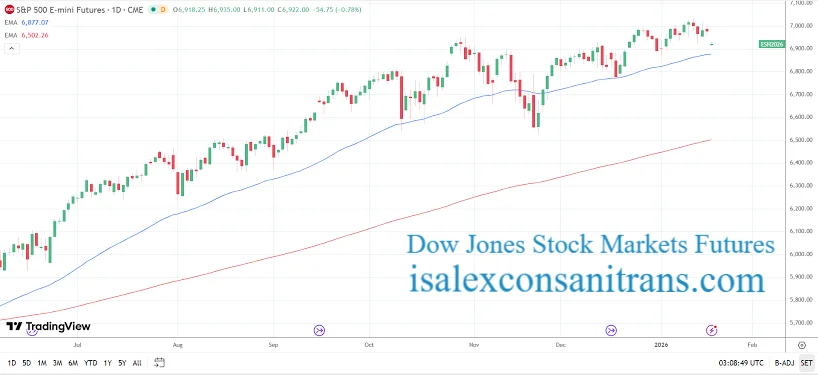
Dow futures offer an early signal of market sentiment, but they are not a guaranteed predictor of the day’s trading session. Short answer: they show what traders expect right now, based on available information — and that expectation can change fast.
Futures prices react to:
- Overnight corporate earnings releases
- Global market events, including movements in Asian and European indices
- Economic data (jobs reports, inflation prints, Federal Reserve commentary)
- Geopolitical developments
- Broad shifts in risk appetite across equity derivatives markets
Because the futures market has lower relative volume than the full cash session, a premarket move can sometimes overstate or understate how the actual opening will play out once institutional order flow enters at 9:30 a.m. ET.
Dow Futures and Market Rebounds
Futures markets are also where the earliest signs of a rebound after a selloff typically appear. A sharp overnight decline followed by Dow futures stabilizing or turning positive before the open is often read as an early signal that panic selling may be easing — though experienced traders treat this as one data point among many, not a standalone signal to act on.
Dow Jones Futures vs. the Dow Jones Industrial Average
The core difference: the DJIA is the actual stock market index calculated from the prices of its 30 component companies during the cash session, while Dow futures are a separate, tradable derivative contract based on where traders expect that index to be. Futures trade nearly continuously, including overnight and premarket, while the DJIA itself only exists as an official calculated value during NYSE and Nasdaq trading hours (9:30 a.m. to 4:00 p.m. ET). As expiration nears, the futures price converges with the underlying cash index through cash settlement.
Dow Futures Contract Expiration
Dow futures contracts expire quarterly, following the standard futures cycle: March, June, September, and December. The last trading day is the third Friday of the contract month, after which the position settles in cash based on the Special Opening Quotation. Traders who want continuous exposure typically roll their position into the next quarterly contract before expiration, shifting open interest from the expiring contract to the new front month.
What to Know Before Trading Dow Futures
- Understand the difference between initial margin (required to open a position) and maintenance margin (the minimum equity needed to keep it open)
- Recognize that leverage cuts both ways — the same multiplier that amplifies gains also amplifies losses
- Watch contract rollover dates to avoid unexpectedly trading a thinly liquid expiring contract
- Compare YM and MYM based on your account size and risk tolerance rather than defaulting to the larger contract
- Treat premarket futures moves as directional context, not a certainty about how the cash session will trade
Frequently Asked Questions
What Are Dow Futures?
Dow futures are cash-settled derivative contracts based on the Dow Jones Industrial Average, traded on CME Globex under the tickers YM (E-mini) and MYM (Micro E-mini).
What Hours Do Dow Futures Trade?
Dow futures trade nearly 24 hours a day, from Sunday at 6:00 p.m. ET through Friday at 5:00 p.m. ET, with a daily maintenance break around 5:00–6:00 p.m. ET.
How Big Is One E-mini Dow Futures Contract?
One E-mini Dow (YM) contract has a $5 multiplier per index point, meaning its notional value equals the current DJIA level multiplied by $5.
Are Dow Futures Cash-Settled?
Yes. Both YM and MYM contracts settle in cash based on a Special Opening Quotation calculated from the DJIA components on the contract’s expiration day, with no physical delivery involved.
What Is the Difference Between YM and the Dow?
YM is a tradable futures contract that reflects expectations about the Dow Jones Industrial Average, while the Dow itself is the actual index calculated from its 30 component stocks during official market hours.
Frequently Asked Questions
What are Nasdaq futures?
Nasdaq futures are a separate equity index futures product tracking the Nasdaq-100 index, traded similarly to Dow futures on CME Globex, and often watched alongside Dow and S&P 500 futures for a broader read on market sentiment across tech-heavy versus blue-chip stocks.
Where can I see Dow Jones stock markets futures today?
Real-time Dow futures pricing is available through CME Group’s own data feeds, as well as financial platforms like Bloomberg, CNBC, Yahoo Finance, and most brokerage trading platforms that offer futures market access.
Is there a live chart for Dow Jones stock markets futures today?
Yes. Most major financial data providers and brokerage platforms that support futures trading offer live, continuously updating charts for YM and MYM contracts throughout the nearly 24-hour trading session.
What will Dow futures look like for tomorrow?
Dow futures for the next trading session become active once the current session’s maintenance break ends, typically opening for the new session around 6:00 p.m. ET, and will reflect any market-moving news that develops overnight.
Can I check a Dow Jones futures live chart for tomorrow in advance?
Not exactly — futures pricing for the next session only becomes available once that session opens after the daily break. Before then, you’re viewing the current or most recently closed session’s chart.
Where can I see Dow Jones and Nasdaq futures live together?
Many financial news sites and trading platforms display Dow, S&P 500, and Nasdaq futures side by side in a single dashboard, making it easy to compare sentiment across major U.S. indices in real time.
What do Dow futures look like heading into Monday?
Futures reopen Sunday evening (around 6:00 p.m. ET) ahead of Monday’s cash session, and early Monday pricing often reflects weekend news, global market moves, and any Friday after-hours developments.
Why are Dow futures up?
Dow futures typically rise on positive corporate earnings, encouraging economic data, dovish Federal Reserve commentary, or easing geopolitical tensions — essentially, any development that improves near-term market sentiment toward the 30 companies that make up the index.
Author Bio: Hamid Ali is a finance and markets writer covering stock indexes, futures, investing, and U.S. financial markets.
He focuses on making complex market concepts, trading terms, and financial data simple and easy to understand.
Author Name: Hamid Ali
Email: johanharwen314@gmail.com
Also Read: